
ILL: The lines made on corrugated cardboard sheets in the corrugating machine, slotters, or die-cutting blades to allow folding. In printing, this is called “pilyaj,” while corrugated cardboard manufacturers refer to it as a rill.
SHEET (SAFIHA): Corrugated cardboard sheets cut to desired dimensions on a corrugating machine. The term “safiha” is a traditional industry term.
OVERLAP (BINDING): The edge of a box where the closing flaps meet in the center and overlap to the desired size.
FLAP : The extension flap corresponding to the length dimension of the box.
COATING: The process of covering the corrugated cardboard surface with various materials to increase resistance to water, moisture, and oil. Traditionally, wax was used; today, water-based products are preferred to allow paper recycling. Applied in the corrugating machine.
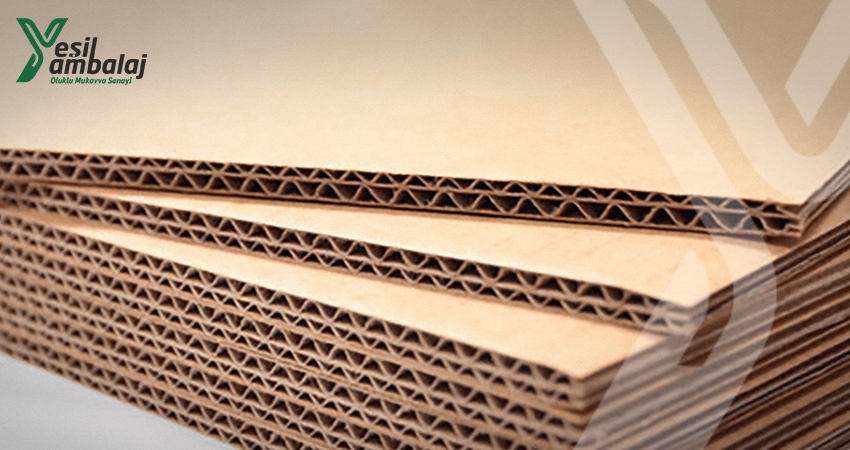
FLUTE: The wave-like shape seen in a cross-section perpendicular to the corrugations.
FLUTE PITCH : The distance between adhesion points of the flute in single-wall or corrugated cardboard.
FLUTE HEIGHT : The height between the top and bottom arches of the fluted paper.
NARROW FACE : The face of the box formed by width and height.
GLUING FLAP : A narrow strip (25–40 mm wide, box height long) joining the narrow and wide faces of a corrugated cardboard sheet to form a prism.
IMPREGNATION (EMPRENYE): The process of impregnating fluting paper with paraffin or other materials in the corrugating machine to improve durability, moisture resistance, and stacking strength.
WIDTH FLAP: The extension flap corresponding to the width of the box.
ZIPPER KNIFE : Paired knives used in corrugated cardboard boxes to facilitate opening. Used in die-cut production.
WIDE FACE : The face of the box formed by length and height.
VENT HOLE : Holes, usually round, cut with special dies in corrugated boxes to allow product ventilation.
EDGE TRIM : The piece cut from the edge of the sheet passing through the slotter to ensure dimensional accuracy.
FLAP TRIM : The piece cut from the top and bottom of the gluing flap.
FLUTE DIRECTION : Represented by an internal triangle according to FEFCO. Perpendicular to machine direction in corrugators; parallel to production direction in box-making machines.
CORRUGATED RILL : Rills applied in the corrugating machine to allow folding of box flaps. Always perpendicular to flutes.
PERFORATION: Partial cuts along a line to allow folding of corrugated cardboard sheets in both directions (inward and outward). Used in die-cut production.
PREPRINTING: Printing on liner paper as a roll before corrugating so that corrugated sheets come out printed.
SKIP FEED: When the sheet length exceeds the slotter cylinder circumference, the sheet is fed to the machine for two cylinder rotations while skipping one pass.
SLOT TRIM : The scrap produced from the slot opening.
SLOTTER RILL : Rills applied in the slotter to form box side faces. Parallel to flutes.
SLOT : Cuts made after slotter rills to form box flaps.
TEAR TAPE: Polypropylene tear tape (4–6 mm wide) applied perpendicular to flutes at specific points on the corrugated sheet to facilitate box opening.
HANDLE : Holes, usually 30×90 mm, on narrow faces of boxes to facilitate carrying. Can be full or half cuts made with special dies.
UPS-OPS-TWIN FLUTE-DUAL ARCH: A technique where two low-grammage papers are glued together and fluted to replace a single fluting sheet, improving strength and stacking performance.
EXTENDED GLUING FLAP: In glued boxes, the gluing flap is extended (about 40 mm) over the corrugated rill to prevent flap opening.
 Yeşil Ambalaj; Within the body of Yeşil Group, which has been operating since 1995, it started to serve in the Corrugated Cardboard Box Packaging sector in Diyarbakır as of the beginning of 2016.